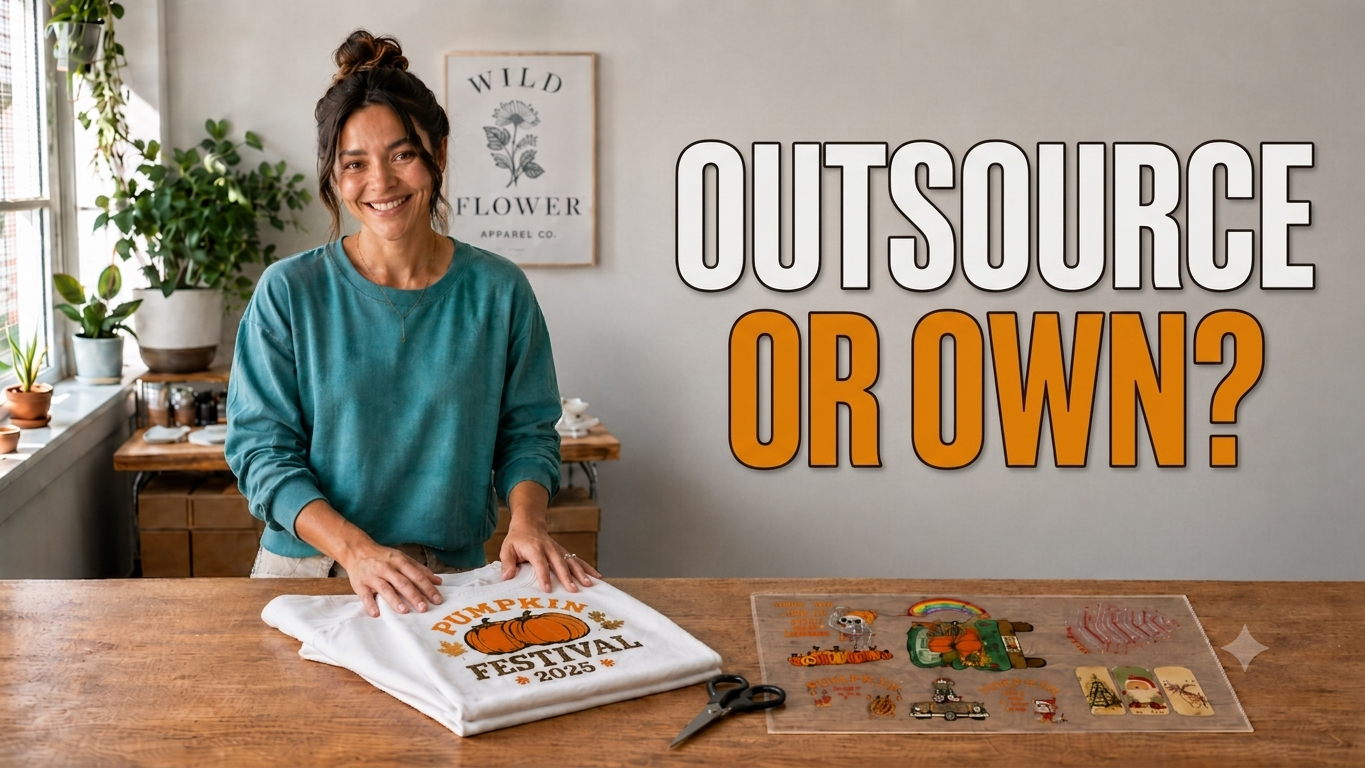
More print shops are choosing to buy custom DTF transfers instead of investing in DTF printers, reducing upfront costs and maintenance.
For most of the last decade, the story of DTF was a story about machines. Shops that wanted in on Direct-to-Film bought a printer, learned to manage white ink, and brought production in-house. Heading into 2026, a quieter shift is running alongside that one: a growing share of shops and sellers are choosing not to own a printer at all, and to buy their transfers ready-made instead.
It is not that in-house DTF is fading. Grand View Research values the global Direct-to-Film printing market at roughly $2.72 billion in 2024, with projections putting it near $3.9 billion by 2030 at around 6% annual growth. That growth is real and broad. But the equipment market tells only part of the story. The businesses driving the outsourcing trend mostly sit in an adjacent one: print-on-demand, which Grand View Research pegs at $10.8 billion in 2025 and expects to grow to more than $57 billion by 2033, a compound rate near 24% a year. Alongside every shop investing in hardware, there is now a marketplace seller, a boutique brand, or a small decorator who has decided that outsourcing the print step to an on-demand service like DTF Printer is the smarter use of their capital. Understanding why is worth a closer look, because it tells you something about where the entry tier of this market is heading.
The shift, in plain terms
The build-versus-buy question is not new to manufacturing, but DTF makes it unusually sharp. A production printer is a real capital commitment plus an ongoing operating burden. A ready-made transfer is a variable cost you only incur when an order comes in. For a business with steady, high volume, owning the machine almost always wins on unit economics. For a business with low or unpredictable volume, the math frequently tips the other way.
That second group has grown quickly, and the numbers behind print-on-demand explain why. On-demand apparel, marketplace storefronts, and side-hustle sellers all share the same profile: variable demand, thin starting capital, and no appetite for maintaining production equipment. For them, outsourcing the transfer is less a compromise than a fit.
Why the math changed
Three factors have made outsourcing more competitive than it was a few years ago.
White ink is still the tax on ownership. DTF depends on a white underbase, and the titanium-dioxide pigment that makes white ink opaque is heavier than standard colour ink. It settles within hours and clogs the printhead when a machine sits idle. High-volume shops keep their printers moving and stay ahead of it. Low-volume owners do not, and the cost lands hardest on exactly the businesses least able to absorb it: a clogged printhead is a $900-plus replacement part, out-of-warranty repairs run $600 to $1,500, and avoiding that fate means a daily maintenance routine whether or not you have orders to fill. Outsourcing removes that failure mode entirely.
No-minimum ordering changed the entry point. Ready-made transfer suppliers on both sides of the Atlantic now routinely accept single-unit orders, which means a seller can test a design for the cost of one transfer rather than a production run. That lowers the risk of trying a new product to almost nothing, and it maps neatly onto how marketplace sellers actually operate: list first, produce once it sells.
Gang sheets closed the cost gap. The old knock on outsourcing was per-unit cost. Gang sheets, where many designs are arranged onto one large sheet and priced by the space used rather than by the number of designs, narrowed that gap considerably. A seller batching a week of orders onto a single sheet pays a rate that competes with small in-house runs, without the overhead.
Where the break-even sits
None of this means outsourcing wins at every volume. It does not. The crossover point is surprisingly consistent across the cost comparisons published by suppliers and shops: somewhere around 175 to 200 prints a month.
Below roughly 100 prints a month, buying transfers is almost always cheaper once you account for the printer, ink, film, powder, maintenance time, and the downtime a lightly used machine inevitably suffers. Above 500 a month, owning wins clearly, because the per-unit cost of running your own line, on the order of a few cents per square inch in raw materials, is simply hard to beat at scale. The middle band is where the decision gets genuinely close, and where it depends less on a spreadsheet than on whether you actually have the space, the staff, and the order book to keep a machine busy.
Entry-level DTF printers now start around $500 to $3,000 for converted desktop units, with mid-range systems running $3,000 to $10,000 and industrial lines well beyond that. Those numbers look approachable. The trap is that the sticker price is the smallest part of ownership, and the ongoing costs fall due whether or not the orders arrive.
The domestic turnaround factor
There is a second trend feeding the same shift: buyers increasingly care where a transfer is printed and how fast it arrives. Long overseas lead times do not fit an on-demand model where a customer is already waiting. That has favoured domestic suppliers who can turn orders around quickly, and a policy change has sharpened the point.
In the United States, the long-standing $800 de-minimis exemption that let low-value parcels enter duty-free ended for all countries on 29 August 2025, subjecting small imported shipments to duties that on apparel average well over 20%. A PRINTING United Alliance survey of decorators and printers found the large majority expected tariff changes to affect their business, and nearly 40% believed they would encourage domestic sourcing. The cost advantage of ordering cheap transfers from overseas, in other words, has narrowed just as the speed advantage of buying close to home has become decisive.
This is where the outsourcing model has become genuinely viable rather than merely cheap. A domestic supplier that prints locally and dispatches within a day or two lets a small seller order custom DTF transfers as demand comes in, with no minimum, and offer turnaround times that would once have required owning equipment. Speed, not just price, is what makes buying transfers a real alternative to making them.
Who it suits, and who it does not
The honest read is that neither model wins outright. They serve different businesses.
Outsourcing tends to suit low or variable volume, sellers testing new designs, marketplace and on-demand operators, and anyone who would rather not run production equipment. The appeal is zero maintenance, no capital tied up in a machine, and the ability to scale spend with sales.
Owning still wins for steady, high-volume production of repeat designs, shops with the space and staff to maintain a machine on a schedule, and decorators who want full control over colour, materials, and timing. At sufficient volume, the per-unit savings of in-house printing are simply hard to beat.
The mistake, in either direction, is choosing the model that fits the business you imagine rather than the one you have. A shop that buys a printer before it has the order book to keep it busy inherits all the ownership costs and few of the benefits. A high-volume operation that keeps outsourcing leaves margin on the table.
The 2026 outlook
Expect both models to keep growing, but not evenly. In-house DTF should keep expanding among established shops and mid-sized decorators, where volume justifies the investment and dedicated printers already make up the largest slice of the market. The faster growth, in unit terms, is likely to come from the entry tier: the marketplace sellers, boutique brands, and part-time operators for whom on-demand transfers lower the barrier to starting from thousands of dollars to almost nothing. That expectation tracks the print-on-demand growth figures more than it does any single DTF forecast, and it is a reasoned projection rather than a settled fact.
That entry tier matters more than its individual order sizes suggest. It is where most new participants enter the DTF market, and industry operators consistently describe the same progression: a seller who starts by buying transfers, watches the monthly outsourcing bill climb, and eventually realises it would cover a machine of their own. Seen that way, the rise of on-demand transfers is not a threat to the hardware side of the industry. It is the on-ramp feeding it.
About the Author