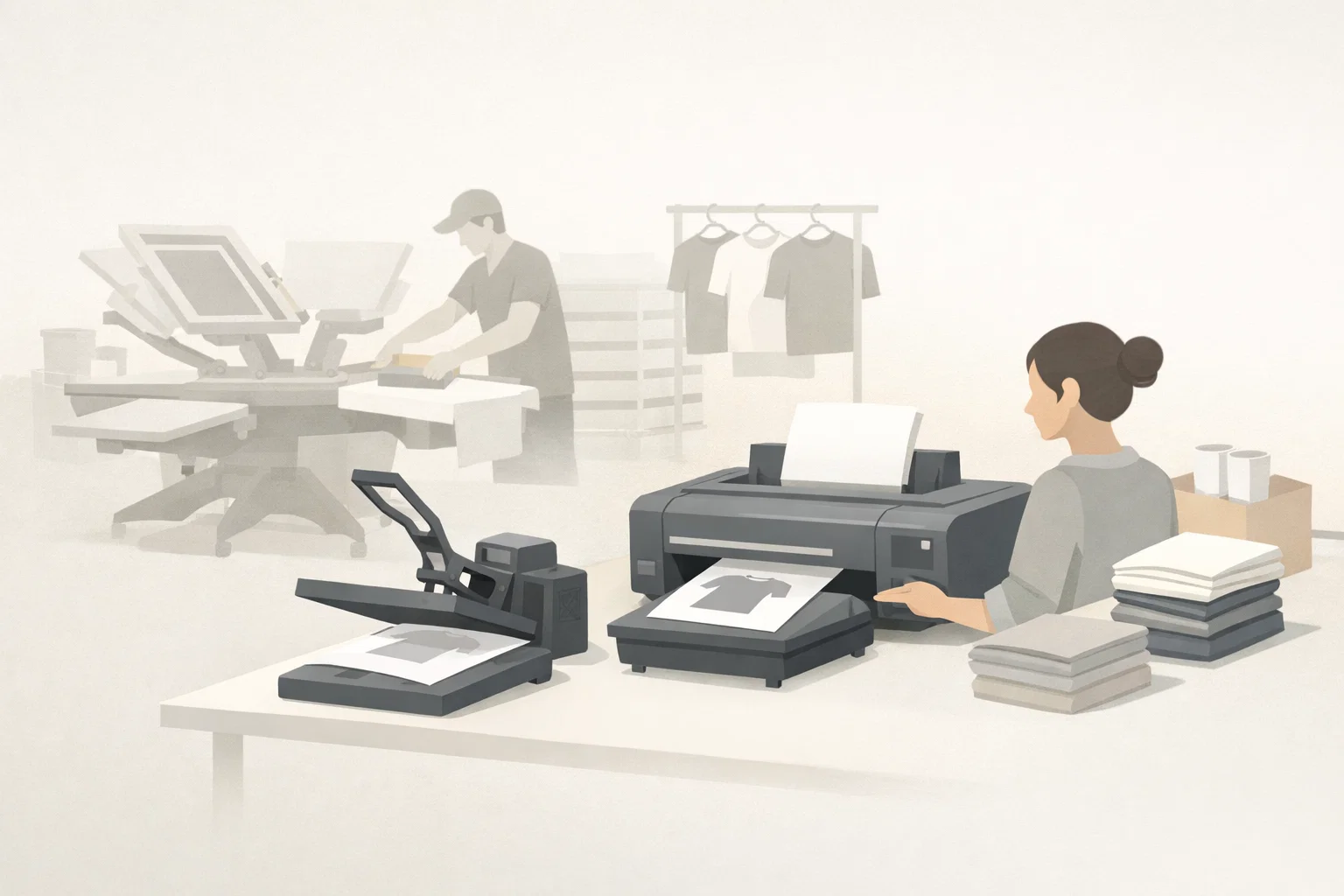
Small apparel shops are quietly reorganizing production workflows in 2026.
For much of the past three decades, screen printing sat at the center of small apparel production. It defined shop layouts, staffing decisions, pricing models, and delivery timelines. In 2026, that position is changing.
Across small and mid sized apparel shops, screen printing is no longer disappearing, but it is quietly losing its role as the primary production method. Instead, it is increasingly treated as a secondary service, used selectively rather than by default.
This shift is not being driven by ideology or technology hype. It is being driven by workflow reality.
Production Priorities Are Changing Inside Small Shops
Small apparel businesses today face a very different operating environment than they did even five years ago. Orders are more fragmented, design variety has increased, and customers expect faster turnaround regardless of volume.
Screen printing remains efficient at scale, but it performs poorly when demand becomes unpredictable. Setup time, labor coordination, and the need to batch orders all introduce friction into modern workflows.
As a result, many shops are reorganizing production around methods that allow continuous output without preparation delays. In these environments, screen printing still exists, but it is no longer the first option when an order arrives.
Screen Printing Is Still Used, Just Not First
Industry conversations increasingly reflect the same pattern. Screen printing is now reserved for jobs that justify its setup cost, such as large runs with fixed designs. Everything else is handled through alternative workflows.
In practical terms, this means:
-
Custom orders are routed away from screen printing
-
Short runs bypass setup entirely
-
Reorders are fulfilled without repeating preparation steps
-
Production schedules are no longer built around batching
For shop owners, this reduces operational strain while maintaining the ability to handle high volume work when it makes sense.
Labor and Scheduling Are Driving the Shift
Labor availability has become one of the most significant constraints for small apparel businesses. Screen printing requires coordinated steps and trained staff availability at specific points in the process.
More flexible production methods allow smaller teams to operate efficiently without rigid scheduling. Jobs can move independently through production without waiting for setup windows or team coordination.
This flexibility has become especially valuable as shops manage mixed order types throughout the day rather than predictable production blocks.
Customers Rarely Notice the Change
From the customer perspective, little appears different. Garments still arrive on time, prints still meet quality expectations, and pricing remains competitive.
Internally, however, the production logic has shifted. Screen printing is no longer the backbone of daily operations. It has become a specialized tool, used when volume demands it, rather than a system that defines how the business runs.
This separation between customer experience and internal workflow has allowed the transition to happen without drawing attention.
What This Signals for the Apparel Printing Industry
The repositioning of screen printing does not represent decline. It represents specialization. As production models diversify, methods that once dominated entire shops are finding more focused roles.
For small apparel businesses, the trend suggests a future built around adaptable production first, with traditional methods supporting that flexibility rather than limiting it.
The change is not dramatic, and it is rarely discussed publicly. But inside production rooms, the shift is already well underway.
Screen printing is still present. It is simply no longer in charge.
About the Author