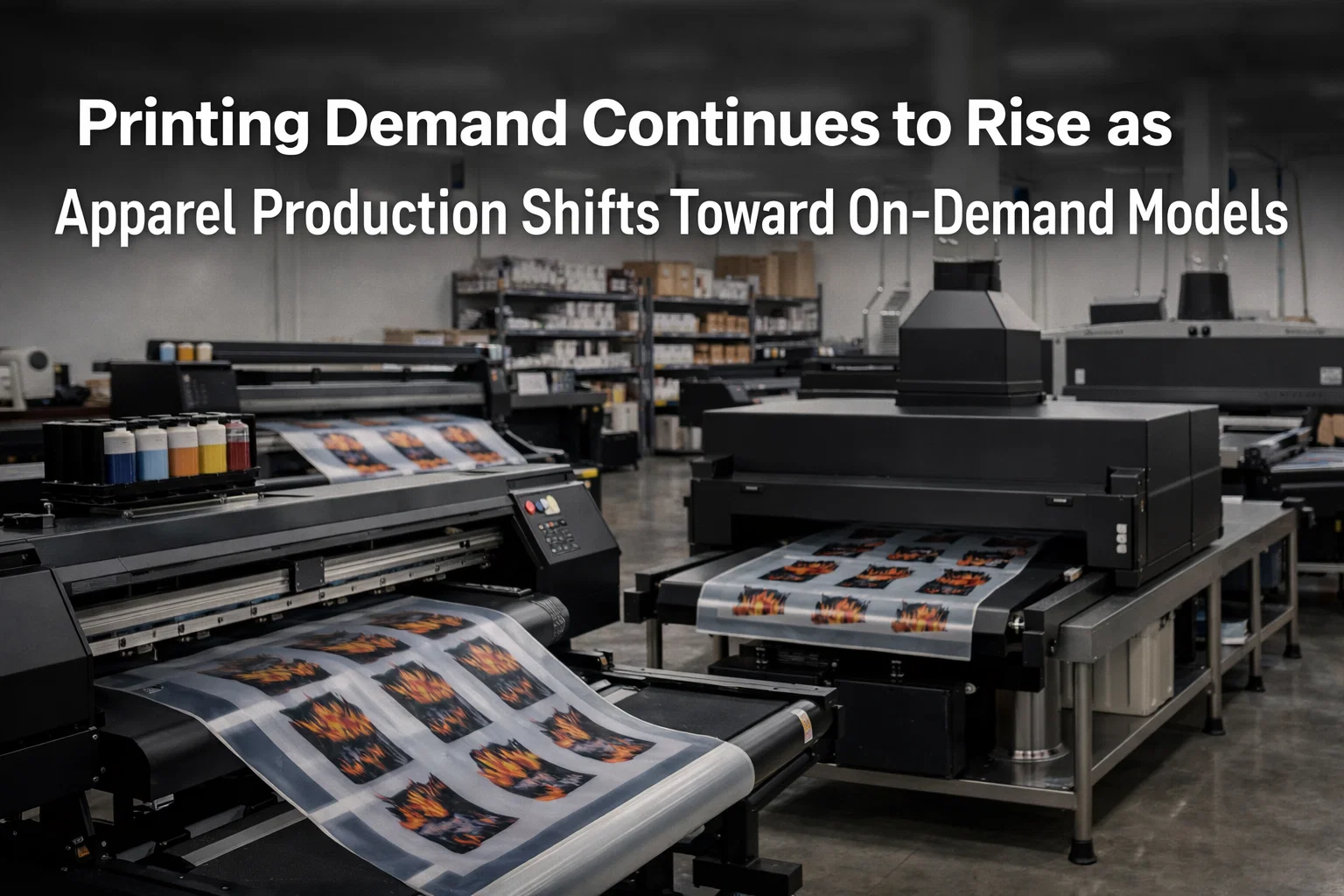
Printing demand continues to rise as apparel production shifts toward on-demand models.
Across global print markets, Direct-to-Film technology is increasingly positioned as a standard production method rather than an emerging alternative. As apparel brands and print service providers adapt to on-demand manufacturing, this printing approach continues to gain relevance for its flexibility, scalability, and broad material compatibility.
The shift toward localized production, shorter product cycles, and customization-driven demand has accelerated adoption across small, mid-size, and growing commercial print operations. Industry observers note that this workflow aligns closely with current market realities, where speed, low minimums, and consistent output are essential.
Rather than replacing traditional printing methods outright, it has established itself as a practical solution within modern hybrid production environments. Its growing role reflects broader changes in how apparel and merchandise are produced, fulfilled, and delivered.
From Alternative Solution to Core Production Method
This printing method initially gained attention for its ability to handle multiple fabric types without complex pretreatment requirements. Over time, that flexibility shifted perceptions from niche or backup usage into a core production role.
Many print service providers now rely on this workflow as their primary solution for short-run and on-demand orders. The ability to produce transfers in advance and apply them when needed allows businesses to reduce finished-goods inventory while maintaining fast turnaround times.
For small and mid-size shops, it offers a balance between accessibility and scalability, making it a long-term investment rather than a temporary solution.
Equipment Demand Signals Market Maturity
As production volumes increase, demand has expanded beyond entry-level printers to include supporting equipment and automation. Conveyor curing systems, automated powder shakers, and integrated curing solutions have become standard upgrades for growing operations.
Suppliers report that shops scaling output prioritize consistency and throughput over manual processes. Improvised curing methods are increasingly replaced by dedicated equipment designed to deliver repeatable results at higher volumes.
This transition suggests the market is entering a more mature phase, where operational efficiency and production reliability play a central role.
On-Demand Manufacturing Drives Adoption
The growth of on-demand manufacturing has been a major factor behind adoption. Brands operating in e-commerce, influencer merchandise, and limited product drops require production methods that can respond quickly to fluctuating demand.
This workflow supports that model by allowing transfers to be produced in batches and stored until orders are confirmed. The approach reduces inventory risk while enabling rapid fulfillment during peak demand periods.
For many apparel businesses, it has become the link between customization and scalable production.
How This Technology Fits Among Other Printing Methods
While sublimation, DTG, and screen printing remain essential tools, this approach occupies a distinct position within the printing landscape. Unlike sublimation, it is not limited to polyester or light-colored fabrics. Compared to DTG, it offers broader material compatibility with faster setup times.
Screen printing continues to dominate large, uniform production runs, but this method provides a more efficient solution for variable designs and short-run orders. As a result, many shops now operate hybrid environments where it complements existing technologies rather than replacing them.
This flexibility has strengthened its role across diverse production scenarios.
Global Accessibility and Market Reach
Another factor supporting growth is accessibility across different regions. Equipment availability and consumable supply chains have expanded globally, making this printing solution viable for businesses of varying sizes and budgets.
As technology becomes more accessible, adoption continues to spread beyond early-adopter markets. This global reach reinforces its position as a widely applicable production method rather than a region-specific trend.
Industry Outlook: Steady Expansion Ahead
Looking forward, industry participants expect DTF printing to remain a foundational technology in apparel and merchandise production. Ongoing improvements in ink chemistry, adhesive powders, and curing efficiency are likely to further enhance durability and production speed.
While market conditions will continue to evolve, the core drivers behind adoption remain strong. Customization, localized production, and fast fulfillment are no longer niche demands but standard expectations.
Its ability to meet these expectations positions the technology for continued relevance through 2026 and beyond.
Final Thoughts
This printing approach is no longer defined by novelty or experimentation. Its steady adoption across print shops and apparel brands reflects a broader transformation in production strategy. As businesses prioritize flexibility, responsiveness, and efficiency, it stands out as a practical and scalable solution.
For the printing industry, the message is clear. The technology is not just growing. It is becoming established.
About the Author