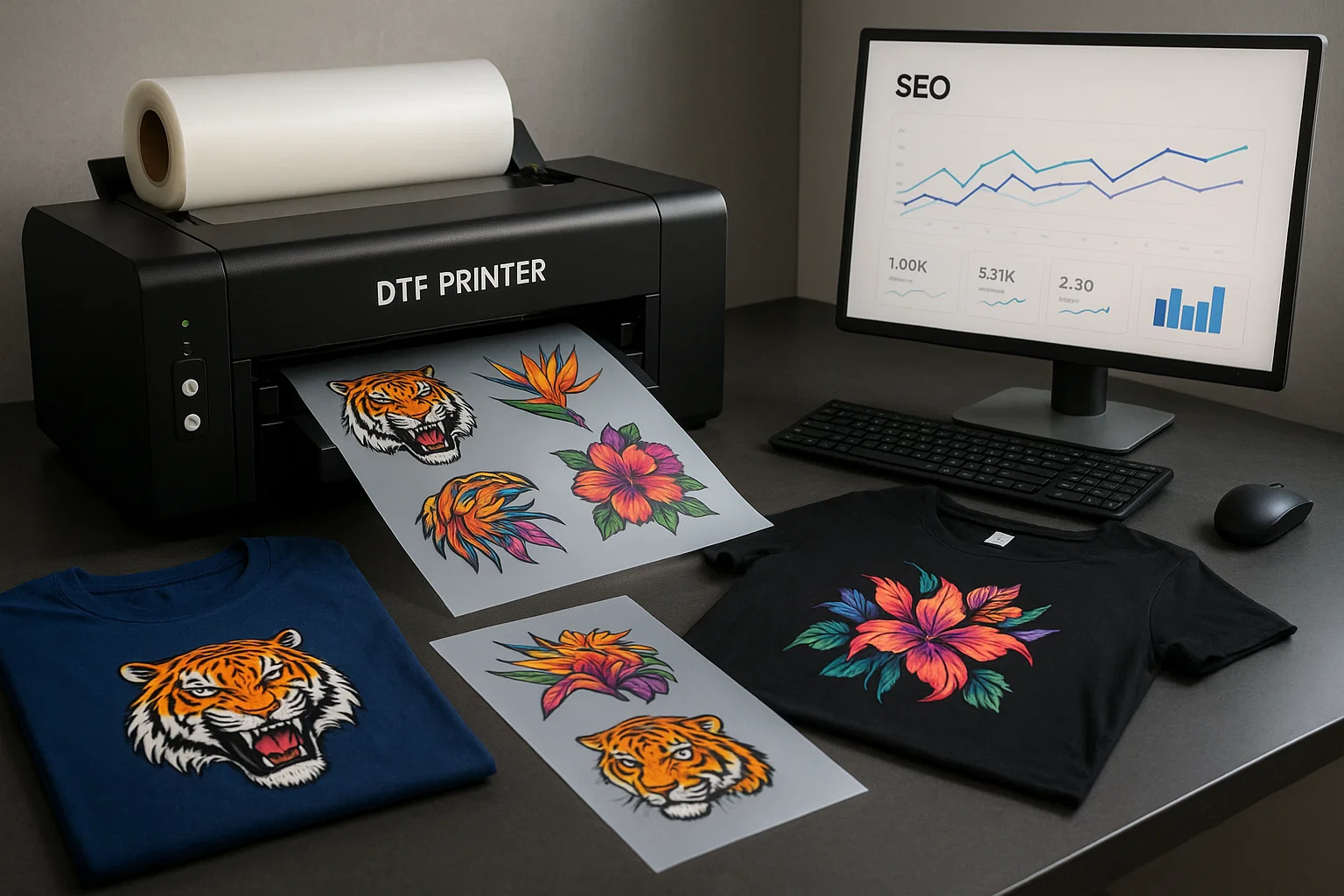
A modern DTF printer producing high quality transfers while SEO performance metrics display on a computer, showing the connection between digital visibility and DTF business growth.
The Direct to Film printing industry has entered a period of accelerated growth, reshaping how custom apparel, merchandising, and small batch production are delivered across the world. What began as a niche technology embraced by hobbyists has evolved into a robust commercial ecosystem supplying fashion brands, print on demand operators, event marketers, creative studios, and thousands of independent businesses. As competition intensifies, one factor has become unavoidable. In 2026, SEO marketing is no longer optional for DTF companies. It is the primary driver of visibility, authority, and revenue.
Analysts observing the sector describe a clear shift. Consumer demand for personalized products continues to expand, and buyers expect fast turnaround with rich color reproduction and durable prints. These expectations have pushed DTF businesses to adopt more advanced production methods while simultaneously competing for digital visibility. According to industry specialists at SEOScale, search engines have become the main channel through which customers discover transfer providers, equipment suppliers, and DTF print shops. Businesses that fail to appear in relevant searches are effectively invisible, regardless of print quality or pricing.
The evolution of search behavior in the DTF market
For years, custom printing customers relied on local shops or referrals. Now, the majority begin their journey online. Search queries such as DTF printing near me, custom DTF transfers, DTF printer maintenance, or DTF supplies for small businesses have surged. SEOScale’s internal trend data indicates that DTF related keyword volume has increased consistently for three years, with some terms more than doubling in monthly searches. This trend shows no signs of slowing.
Consumers have developed different expectations in the digital age. They want immediate information, transparent pricing, and a clear explanation of process and quality standards. Search results have become the modern evaluation system. When a business ranks highly, customers interpret that placement as a sign of credibility. If a business fails to appear on the first page, customers often assume the company lacks experience or reliability.
The market now favors brands that invest in SEO early. Those with optimized websites, structured content, and strong authority signals consistently outperform competitors with weaker search presence. SEOScale’s analysts note that early adopters of SEO in the DTF sector have created advantages that compound each year.
Search visibility as a direct revenue driver
Organic search is one of the most powerful revenue channels in the DTF industry. Each ranking position represents a measurable difference in traffic and conversions. Companies that appear in the top three positions for high intent keywords consistently receive a disproportionate share of orders. Meanwhile, companies on the second page are rarely seen.
As advertising costs continue to rise, SEO has become the most cost effective and sustainable way for businesses to attract customers. Paid ads have a short lifespan and require constant budget allocation. In contrast, SEO gains accumulate over time. When a website ranks highly for multiple categories such as DTF printers, DTF transfers, DTF film, or bulk gang sheets, it captures predictable long term traffic without the need for continuous ad spend.
Experts at SEOScale emphasize that organic traffic is especially valuable in 2026 because customers are becoming more selective. They want to research before buying. They read tutorials, compare suppliers, and review real world print samples. Businesses that rank well for both commercial terms and educational content earn trust early in the buying process.
The rise of local intent and why it matters for DTF shops
While the industry is global, local demand still plays a major role. Many customers prefer to work with shops that can offer same day or next day production, lower shipping costs, and easier communication. As a result, local SEO is now one of the most important components of a successful DTF business strategy.
When customers search for DTF transfers in Chicago or custom prints in Los Angeles, Google displays a combination of organic results and Google Maps listings. Data from SEOScale shows that local pack results receive a large percentage of clicks, especially from mobile users who need immediate service. Shops that invest in their Google Business Profile, maintain consistent contact information, and gather customer reviews tend to outperform even larger national competitors.
Local SEO has effectively replaced the traditional storefront. It is often the first impression a potential customer sees. Ensuring accurate business details, publishing location specific content, and maintaining strong service area pages have become essential tasks for any shop that wants to thrive in 2026.
Content as a signal of expertise and trust
In a crowded industry, expertise is one of the strongest differentiators. Customers want to understand how DTF works, what materials are best, how long prints last, and how to troubleshoot common issues. This demand has created an environment where educational content significantly influences search rankings and customer trust.
SEOScale’s research shows that DTF businesses publishing in depth guides, tutorials, and comparison articles consistently achieve higher conversion rates. The reason is simple. These businesses become authoritative sources of information. They help customers solve problems before a purchase, which builds goodwill and increases confidence.
Examples of valuable content include step by step printing guides, explanations of curing errors, maintenance advice for DTF printers, side by side comparisons of powders and films, and breakdowns of pricing models for small batch orders. High quality content not only attracts organic traffic but also reduces customer service volume because many questions are addressed proactively.
Competitive pressure and the equalizing force of SEO
The rapid expansion of the DTF sector has created a crowded marketplace. Large suppliers, boutique studios, equipment vendors, home based businesses, and international manufacturers all compete for the same online audience. This level of competition could easily overwhelm smaller businesses, but SEO acts as an equalizer.
Search engines do not favor companies based on size. They prioritize relevance, quality, and authority signals. A small shop with strong SEO can outrank a major brand if it provides more valuable content and a better user experience. This dynamic gives every business a chance to succeed.
SEO also compounds like an investment. A business that starts early builds domain authority that becomes hard for late competitors to match. SEOScale’s analysts point out that many top ranking DTF sites today began optimizing years ago, and the gap between early adopters and newcomers continues to widen.
Google’s algorithm changes and their impact on the DTF industry
Google has implemented several algorithm updates that prioritize authentic businesses and user focused content. These changes heavily affect the DTF sector, which includes many newly launched websites with varying levels of quality and legitimacy.
SEOScale’s technical specialists note that many DTF businesses lose ranking due to heavy image files, cluttered layouts, and incomplete product data. Page speed is a significant ranking factor, and product galleries in this industry tend to be large. Businesses that compress files, optimize server performance, and simplify user experience tend to improve rapidly.
Algorithm updates also emphasize experience, expertise, and trust. Google is more adept at identifying whether a business is real and reliable. Verified reviews, consistent naming conventions, physical address information, and transparent service descriptions all contribute to stronger ranking signals.
Backlink development as a credibility engine
Backlinks remain one of the most important indicators of authority. In the DTF industry, securing links from reputable news outlets, print industry blogs, creative design magazines, and educational resources significantly boosts visibility. These links serve as third party endorsements that validate a business’s expertise.
SEOScale’s outreach data shows that DTF companies featured in genuine media placements tend to maintain rankings even during major algorithm updates. Guest articles, press releases, community sponsorships, and collaborative content also strengthen backlink profiles. The most successful DTF brands consistently invest in earning these external trust signals.
User experience as a core ranking factor
SEO is no longer simply about keywords. Search engines measure how users interact with a website. If customers stay on the page, engage with content, and navigate easily, Google interprets this behavior as a positive signal. Poor user experience creates the opposite effect.
Customers in the DTF market want clarity. They want to know turnaround times, sizing details, film types, color options, maintenance requirements, and file specifications. Businesses that provide this information in a clean, easy to understand layout benefit from improved search performance.
SEOScale frequently emphasizes that modern SEO and user experience are inseparable. A website that serves the customer well is naturally rewarded by search engines.
Global competition and the future of visibility
DTF suppliers and print shops are no longer competing only within their cities or countries. Global suppliers from China, Turkey, the United States, Germany, and Southeast Asia all aim to capture the same online demand. This international competition intensifies the need for SEO strategy.
Visibility determines which brands customers trust first. The brands that dominate search results become perceived industry leaders, regardless of price. SEO shapes market perception long before a customer reads product descriptions or sees print samples.
As the market expands, SEOScale predicts that search results will become even more competitive. The companies that treat SEO as an essential business function will lead the industry in the coming years.
Long term outlook and why SEO remains essential beyond 2026
All indicators suggest that the DTF industry will continue to grow. Advancements in printer systems, automated workflows, improved ink formulas, and new film technologies will attract more businesses and consumers. As more entrants join the market, the fight for search visibility will intensify.
Businesses that invest in SEO now will secure long term advantages. Organic visibility provides stability in periods when advertising costs fluctuate or consumer demand shifts. It becomes a long lasting foundation for growth.
SEO is not simply a marketing technique. It is a structural business strategy that shapes long term competitiveness. As SEOScale notes, the DTF industry is entering a new era in which digital visibility is as important as print quality.
Final conclusion
The Direct to Film printing industry is evolving rapidly, and 2026 marks a turning point. Search visibility has become the primary determinant of success. Companies that invest in SEO gain an advantage in customer trust, traffic, and brand authority. Those that ignore it risk falling behind in a competitive and expanding market.
SEOScale’s research underscores the message clearly. The winners in the DTF sector will be the companies that combine strong production capabilities with superior digital visibility. In a market driven by innovation and customer demand, the brands that stay visible will be the brands that stay ahead.
About the Author