DTF printer equipment trends in 2026 production environments
As direct-to-film printing continues to expand across small apparel brands and high-volume production facilities, one question dominates equipment discussions in 2026: are DTF printer prices rising again, or is the market stabilizing?
Following rapid adoption in 2024 and 2025, strong demand pushed many entry-level and mid-range systems into temporary supply pressure. Now, with more manufacturers entering the space and production scaling globally, pricing behavior is shifting once again.
For print shops evaluating new investments, understanding current DTF printer price trends is becoming as important as understanding workflow efficiency.
Entry-Level Desktop DTF Printers Remain Competitive
Entry-level DTF printers targeting startups, Etsy sellers, and small apparel brands remain widely available. Increased competition among suppliers has prevented dramatic price spikes in this category.
However, experienced operators caution that the base price does not tell the full story.
Buyers must account for:
-
White ink circulation systems
-
Powder shaker and curing add-ons
-
Maintenance frequency
-
RIP software licensing
-
Ink consumption rates
Shops new to the industry should first understand what is a DTF printer and how it works in real production before comparing equipment tiers, as technical differences directly affect long-term operating costs.
Mid-Range Production Printers See Strategic Upgrades
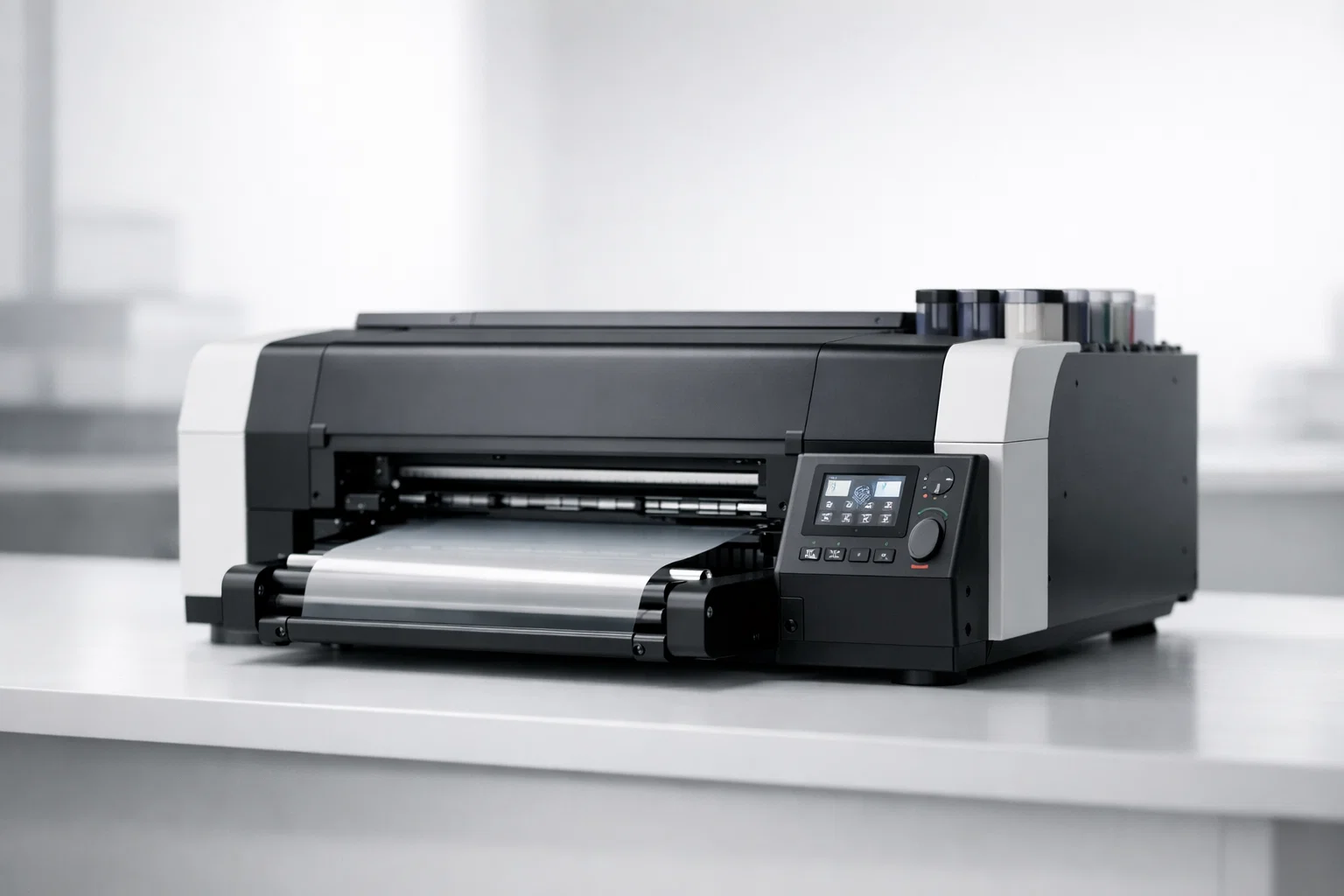
Mid-volume DTF printers used in commercial apparel production are seeing moderate pricing adjustments. Rather than simple inflation, much of the cost shift is tied to upgraded components and automation features.
Manufacturers are increasingly integrating:
-
Improved white ink management
-
Faster curing modules
-
More stable film feeding systems
-
Workflow monitoring software
As discussed in our analysis of DTF printing costs explained: real production expenses in 2026, equipment price is only one piece of the profitability equation. Downtime, reprints, and ink waste often outweigh the difference between two similarly priced machines.
Industrial DTF Systems Focus on Automation and Stability
High-volume industrial DTF systems continue to evolve toward automation-driven efficiency.
Modern systems now prioritize:
-
Automated powder application
-
Integrated curing tunnels
-
Closed-loop white ink systems
-
Production data tracking
With production pressure increasing industry-wide, many shops are also reviewing DTF printer maintenance and troubleshooting best practices before committing to higher-capacity equipment.
While industrial systems carry higher upfront costs, their cost-per-transfer can decrease significantly when operating at consistent volume.
Total Cost of Ownership Is Replacing Sticker Price as the Main Metric
In 2026, serious print operations are shifting away from asking, “What is the cheapest DTF printer?” and toward asking, “What delivers the most stable ROI?”
When evaluating DTF printer price trends, shops should assess:
-
Daily production capacity
-
Ink cost per square foot
-
Film compatibility
-
Reprint risk
-
Service and parts availability
-
Long-term scalability
Print shops experiencing workflow inefficiencies may first benefit from reviewing DTF printing workflow explained: from design to finished transfer before investing in new hardware.
Equipment alone does not fix process instability.
Market Outlook for the Rest of 2026
Industry analysts expect:
-
Increased competition among DTF equipment suppliers
-
More bundled hardware + curing solutions
-
Gradual normalization of entry-level pricing
-
Continued automation at the mid and high-production levels
As the DTF market matures, purchasing decisions are becoming more strategic and data-driven. Print shops are moving away from speculative buying and toward calculated expansion models based on measurable output and operational reliability.
For many operations, the key question is no longer simply how much a DTF printer costs — but how efficiently it can perform under real production pressure.
About the Author